
Use AI and Get 1,000 Visitors a Day: A Practical Guide to AI-Powered Website Traffic
 by Ashish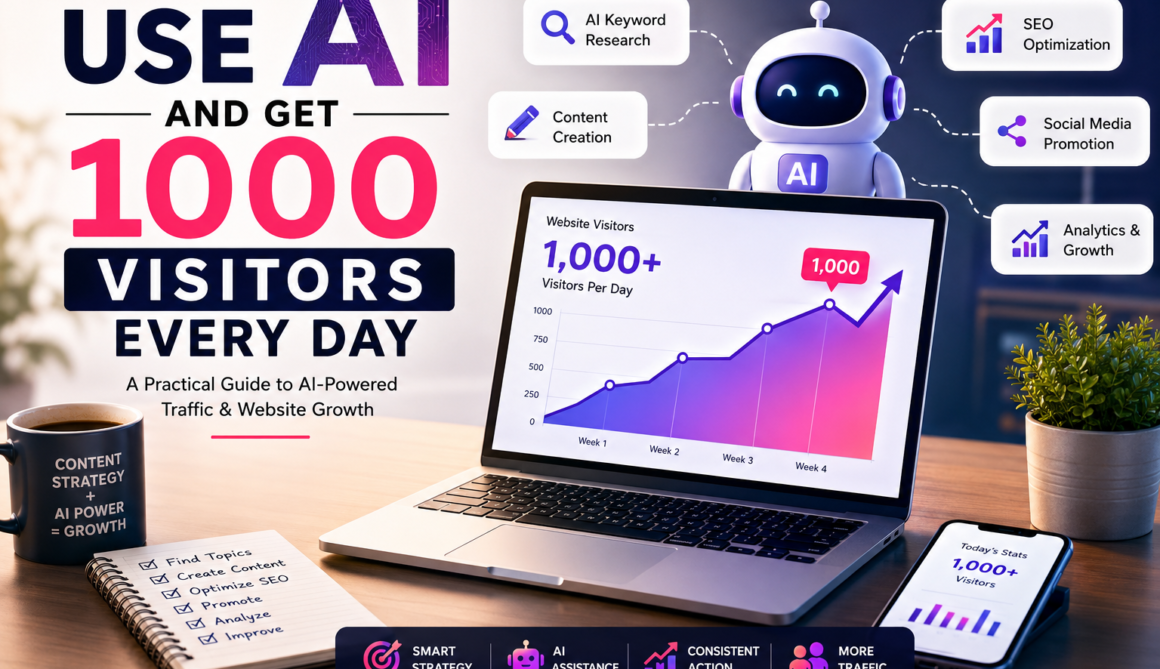
Getting 1,000 visitors a day sounds difficult, especially if you are starting a new website. But AI has changed the way website owners can research topics, create content, optimize pages, and discover new traffic opportunities.
AI cannot magically send 1,000 visitors to your website. However, when you combine AI with SEO, useful content, keyword research, social media, and consistent publishing, it can dramatically reduce the time required to build a traffic-generating website.
Can AI Really Help You Get 1,000 Visitors a Day?
Yes—but there is an important difference between using AI to create content and using AI as a complete traffic strategy.
Publishing hundreds of generic AI-written articles does not guarantee rankings. Search engines increasingly focus on whether content is useful, original, trustworthy, and genuinely satisfies the searcher’s intent.
The better strategy is:
Find demand → Research → Create useful content → Optimize → Publish → Promote → Analyze → Improve
AI can assist with almost every step.
1. Find Topics People Are Actually Searching For
One of the biggest mistakes new bloggers make is writing about topics nobody is searching for.
Instead of asking:
“What article should I write today?”
ask:
“What are people searching for that I can answer better than existing websites?”
AI can help you generate topic ideas around your niche.
For example, if your website is about dating, you could create articles around topics such as:
- How to start a conversation on Instagram
- How to know if someone likes you
- Best first-date conversation questions
- How to make a good dating profile
- Dating mistakes to avoid
- How to find a serious relationship online
- How to approach someone respectfully
The goal is to build a large collection of related content, rather than publishing random articles.
2. Use AI for Keyword Research
AI can help organize hundreds of potential keywords into useful groups.
For example, the main keyword might be:
“online dating”
Related topics could include:
- online dating tips
- best dating apps
- online dating safety
- how online dating works
- dating profile ideas
- dating conversation starters
- serious relationship websites
You can then create a content plan where one main article targets the broader topic while smaller articles answer specific questions.
This creates a topic cluster, helping your website build authority around a subject.
3. Don’t Ask AI to “Write an Article” and Publish It
This is where many AI content strategies fail.
A simple prompt such as:
“Write a 2,000-word article about online dating.”
may produce grammatically correct content, but it can also be generic and repetitive.
Instead, give AI a detailed research brief.
Ask it to:
- Identify the search intent.
- Analyze common questions users have.
- Suggest missing information competitors often ignore.
- Create a logical structure.
- Suggest examples.
- Identify important related keywords.
- Produce original explanations.
- Add FAQs.
- Suggest internal links.
- Create a compelling title and meta description.
Then review and improve the article yourself before publishing.
AI should be your assistant—not your replacement for judgment.
4. Create Content at Scale
This is where AI becomes extremely powerful.
A human writer might struggle to research and organize several articles every day.
With an AI-assisted workflow, you can build a system that helps you:
Keyword → Outline → Draft → SEO optimization → Images → Internal links → Publish
For example, instead of manually creating everything from scratch, you could maintain a spreadsheet containing:
| Keyword | Search Intent | Article | Status |
|---|---|---|---|
| dating profile ideas | Informational | 25 Dating Profile Ideas | Published |
| first date questions | Informational | 50 First Date Questions | Published |
| online dating tips | Informational | Complete Online Dating Guide | Draft |
| dating conversation starters | Informational | Conversation Starters | Published |
This makes content production much more organized.
5. Target Long-Tail Keywords
You don’t always need to compete for extremely difficult keywords.
Instead of targeting:
“dating”
you might target:
“how to start a conversation with a girl on Instagram”
The second keyword is more specific and usually has a clearer search intent.
Thousands of small keywords can collectively generate significant traffic.
For example:
100 keywords × 10 visitors/day = 1,000 visitors/day
You don’t necessarily need one article receiving 1,000 visitors.
You can build traffic from hundreds of pages.
6. Make Every Article Better Than the Average Result
AI can help you create content quickly, but your competitive advantage should be quality.
Before publishing, ask:
- Does this answer the actual question?
- Does it provide practical examples?
- Is anything important missing?
- Is the information accurate?
- Is the introduction interesting?
- Are the headings easy to scan?
- Are there useful images or diagrams?
- Are there relevant internal links?
- Would a real person find this genuinely useful?
If the answer is no, improve the article.
7. Use AI to Create Supporting Content
One article doesn’t have to exist alone.
Suppose you publish:
“How to Create a Great Dating Profile”
You could create supporting articles such as:
- Best dating profile headlines
- Dating profile photo ideas
- Dating bio examples
- Common dating profile mistakes
- How to choose the best profile picture
- Questions to ask someone after matching
Then link these articles together.
This creates a network of relevant content instead of isolated pages.
8. Use Social Media to Accelerate Traffic
Don’t depend entirely on Google.
Turn each article into multiple pieces of social content.
One blog post could become:
- 1 Instagram carousel
- 1 Reel
- 3 short posts
- 5 quote graphics
- 1 Facebook post
- 1 Pinterest graphic
- 1 short video script
AI can help convert the same research into different formats.
This means one piece of research can generate an entire content campaign.
9. Create Images and Videos With AI
Text isn’t the only content AI can help produce.
You can use AI-assisted tools to create:
- Blog illustrations
- Infographics
- Social media graphics
- Short videos
- Video scripts
- Thumbnails
- Explanatory diagrams
Visual content can make articles more engaging and can also give you additional opportunities to attract visitors from social platforms.
10. Build an AI Content Machine
A simple AI-powered publishing system could look like this:
Step 1: Find keywords and trending topics.
↓
Step 2: Group keywords by search intent.
↓
Step 3: Create article outlines.
↓
Step 4: Generate the first draft with AI.
↓
Step 5: Add original information, examples and experience.
↓
Step 6: Optimize title, headings, meta description and internal links.
↓
Step 7: Create an attractive image.
↓
Step 8: Publish the article.
↓
Step 9: Promote it on social media.
↓
Step 10: Monitor traffic and rankings.
↓
Step 11: Update articles that are underperforming.
This process can be repeated every day.
How Long Does It Take to Reach 1,000 Visitors a Day?
There is no guaranteed timeline.
A new website may take months to build meaningful organic traffic, while an established website with authority can grow much faster.
Your results depend on factors such as:
- Website authority
- Competition
- Content quality
- Keyword selection
- Search demand
- Backlinks and mentions
- Technical SEO
- Publishing consistency
- Existing audience
- Industry
Therefore, don’t make “1,000 visitors tomorrow” your goal.
Build toward:
100 visitors/day → 300 → 500 → 1,000 → 5,000+
The Biggest Mistake: Publishing AI Spam
AI makes it incredibly easy to produce content.
That is both its biggest advantage and its biggest danger.
If you publish hundreds of pages containing little original value, repetitive information, inaccurate claims, or content created purely to manipulate search rankings, you may end up with a large website that receives very little traffic.
The goal isn’t:
“How many AI articles can I publish?”
The better question is:
“How much useful information can I provide to my audience?”
A Simple 30-Day AI Traffic Strategy
For the first month, focus on building a strong foundation.
Week 1: Research
Find 100–200 relevant keywords and divide them into categories.
Week 2: Content Creation
Create your first group of high-quality articles targeting realistic keywords.
Week 3: Distribution
Turn your articles into social media posts, videos and graphics.
Week 4: Optimization
Check which pages are receiving impressions and clicks.
Improve titles, introductions, headings, internal links and content where necessary.
Then repeat the process.
Final Thoughts
AI has made website growth much more accessible.
You no longer need a large writing team to research hundreds of topics, create outlines, produce drafts, design content ideas and manage a publishing calendar.
But AI alone won’t give you 1,000 visitors a day.
The winning combination is:
AI + SEO + useful content + keyword research + consistency + promotion + patience
If you build a system around these principles, 1,000 daily visitors becomes a realistic traffic target to work toward, rather than an impossible promise.
The future of blogging isn’t simply about writing more.
It’s about using AI to research faster, create better, publish consistently, and spend more time improving what actually works.